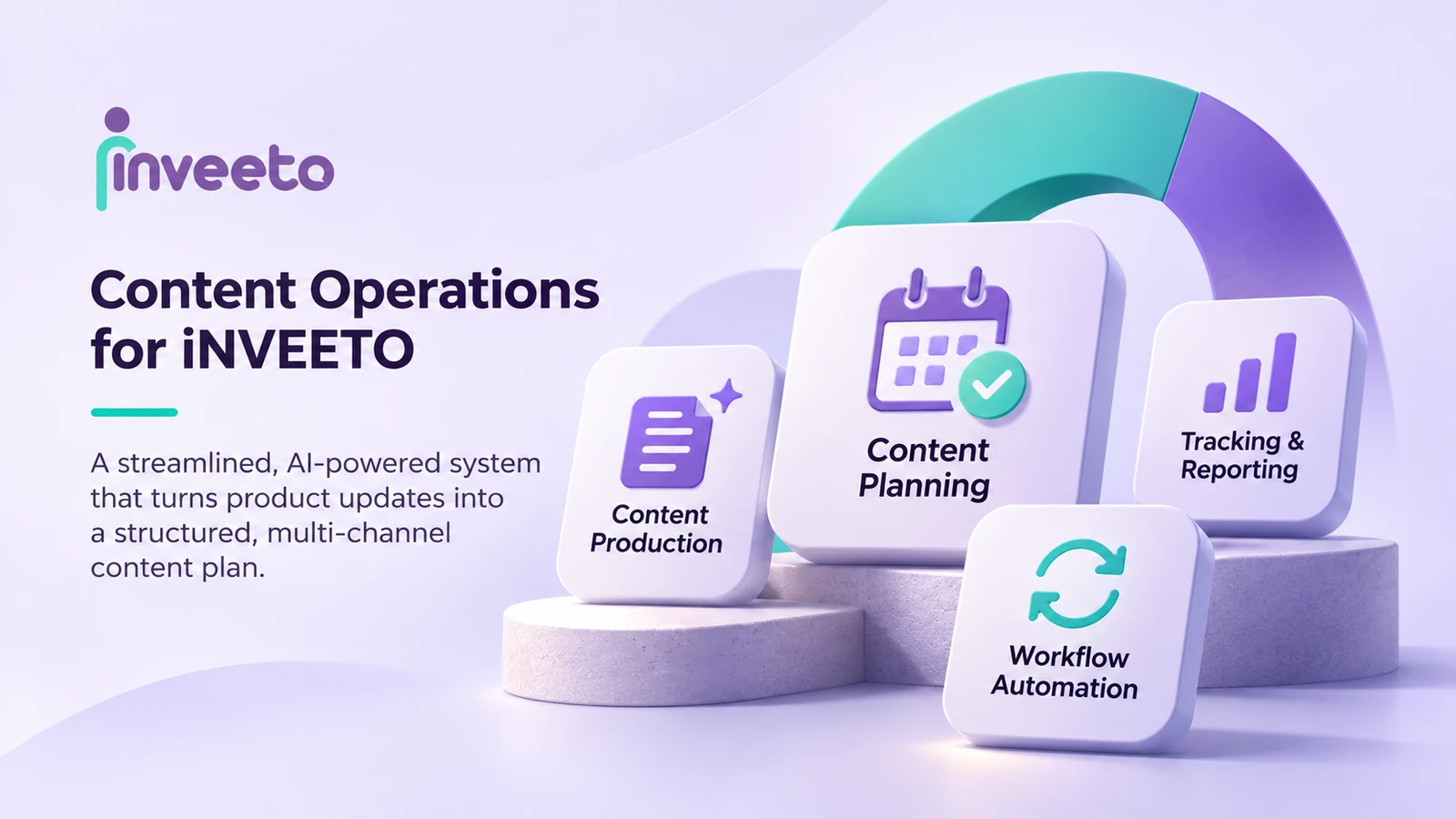
An AI-assisted content operations system that turns every iNVEETO product release into a structured, multi-channel, bilingual content plan, with automated task creation, execution tracking and a central management dashboard.
iNVEETO’s content operations relied on three separate files plus requests exchanged over chat, which scattered information, made it hard to define what each product release required, and weakened execution tracking. I analysed and restructured the existing workflow, then developed a central system that converts each release into a complete content plan (tasks, owners, stages and bilingual publishing requirements), linked to a management dashboard.
My role
Process owner and content operations system developer
I led the project from needs analysis and workflow design through development, testing, documentation and handover. I used Claude (Anthropic) as a development aid while I set the requirements, designed the system logic, made the decisions, and reviewed and tested the outputs.
Process analysis and workflow design
Analysed how information moves from the product team to content and management.
Defined information sources, roles, responsibilities and content approval stages.
Documented 15 design questions and set 17 rules for the tasks and outputs each feature requires.
System development and automation
Directed the build on Google Sheets and Apps Script, with logic that compares each release to the previous one.
Automated task creation by update type, and a tracker linking each task to its owner, due date and stage.
Quality assurance and documentation
Tested functions and scenarios on a trial copy before launch and resolved the issues found.
Produced an 8-section English operating guide and a 40-step Arabic setup guide.
0
formula cells
0
lines of Apps Script
0
automated one-click actions
0
tracked tasks per release
System components
The system, component by component
Release-based content planning automation
The system reads the release log and compares each release to the previous one to identify new features, newly deployed features and improvements, then automatically creates the right outputs: release notes, announcement posts, help-center articles, feature highlights, tutorial videos, FAQs, website feature-page updates, and updates to the About and Pitch materials.
Content lifecycle management and tracking
An integrated tracker across nine defined stages from preparation to publication: owner per task, responsibilities split between the content, review and management teams, deadlines per stage, and late tasks detected automatically from recorded dates rather than updated by hand.
Multilingual content management
A mechanism to manage Arabic and English content, where each language version has its own record linked to the main task, so each version is tracked separately with its own publishing requirements and the Arabic content sits inside the same workflow at an equal level of follow-up.
Marketing content planning
A framework that sustains publishing and topic variety by organizing editorial outputs across digital channels on a clear weekly publishing plan, while keeping the flexibility to absorb updates and new marketing needs.
Dashboard and management reporting
A central dashboard of 12 key indicators and 10 panels, filterable by month, content source and channel, giving management a clear view of planned volume, completed and in-progress outputs, late tasks and their causes, and progress by source, channel and period.
File organization and digital asset management
Automated project-file organization on Google Drive with a unified folder structure (DRAFTS and PUBLISH), consistent file naming, periodic asset-health checks, and management of 16 sales and website assets with review cycles across 9 target sectors.
Before and after
Content sources
Before3 files
After1 system
Release planning
Beforemanual
Afterautomated
Execution tracking
Beforemanual
Aftercentral
Management reports
Beforeon request
Afterlive dashboard
Arabic content
Beforeseparate
Afterlinked
Digital assets
Beforemanual
Afterautomated checks
Results
Unified content operations: scattered content sources became one central system linking product releases to content and marketing requirements.
Evidence: System tested and launched, Nov 2026
Automated content planning: about 15 content tasks created per release from defined rules, instead of a manual task list.
Evidence: End-to-end task-generation test, Nov 2026
Stronger management visibility: a dashboard of 12 KPIs and 10 panels shows outputs, delays and their causes directly.
Evidence: Management dashboard build, Nov 2026
An operable, transferable system: 17 documented task rules with English and Arabic guides.
Evidence: 8-section guide + 40-step setup guide, Nov 2026
Built efficiently in time and cost: analysis, design and development with AI in about 5.5 hours on Google Sheets and Apps Script, with no added software cost.
Evidence: Development log, Nov 2026
Experience and lessons
“Process improvement starts with understanding how work is really done: the hardest part was not writing formulas or code, but turning memory-based procedures into clear, structured rules.
“Accurate data is the basis of effective management: tying task status to dates reduces manual updating and improves the accuracy of tracking reports.
“Content management goes beyond writing and publishing: it means linking content strategy to product needs, responsibilities, marketing channels and approval stages.
“Documentation is part of building a system: a system is only complete when it is documented and can be operated and handed over to others.
Questions, answered
Frequently asked
What is a content operations (ContentOps) system?
It is the system and process behind content, not the posts themselves: how a release, event or campaign becomes a planned, tracked and measurable set of content tasks. For iNVEETO it connects the product release log to a content tracker and a management dashboard, so every release produces its full content plan automatically.
How does AI-assisted content automation work here?
The system reads each release, compares it to the previous one, detects new and improved features, and applies 17 task rules to create about 15 tracked tasks: posts, help articles, videos and sales-material updates. The logic lives in Google Sheets formulas and 785 lines of Apps Script; the AI wrote the code under my direction, and I set every rule.
Can a content operations system be built without expensive software?
Yes. This one runs entirely on Google Sheets and Apps Script: 16,579 formula cells, 11 automated one-click actions and scheduled checks, built in about 5.5 hours at no added software cost. The value is in the process design and the rules, not in a paid tool.
How do you manage bilingual Arabic/English content operations?
Each language version has its own record linked to the main task, with publishing requirements set per language and channel, so the Arabic plan is scheduled, owned and measured inside the same workflow as the English one rather than treated as an afterthought.
Who built this and what do they specialize in?
Zaid Al-Sahili, a digital marketing specialist based in Ramallah, focused on content operations management, workflow automation and bilingual Arabic/English content for SaaS and B2B products. He led the design, development and testing and directed the AI-assisted build.
AI assistant. Please don’t share personal details.
Your privacy, your choice
I use Google Analytics to see which pages and work samples are useful. You can reject it now or at any time (in Europe it only runs if you accept). No advertising cookies, ever. Cookie details